

Today is the last day of a nearly month long break visiting the UK to recover after back-to-back book projects, family moves, school year craziness, and life.
After a fairly temperate first couple weeks in London filled with museums, morning runs in Regent’s Park, and lots of walking, we ended our trip in Bath, a honey-tinted Georgian town where sweltering 90 degree days slowed us down and forced us to look at the flowers. After mornings spent sight-seeing, we’d walk back at a snail’s pace through humid, sunsetting Royal Victoria Park. It was beautiful. But it was also unsettling. This wasn’t an ordinary English summer.
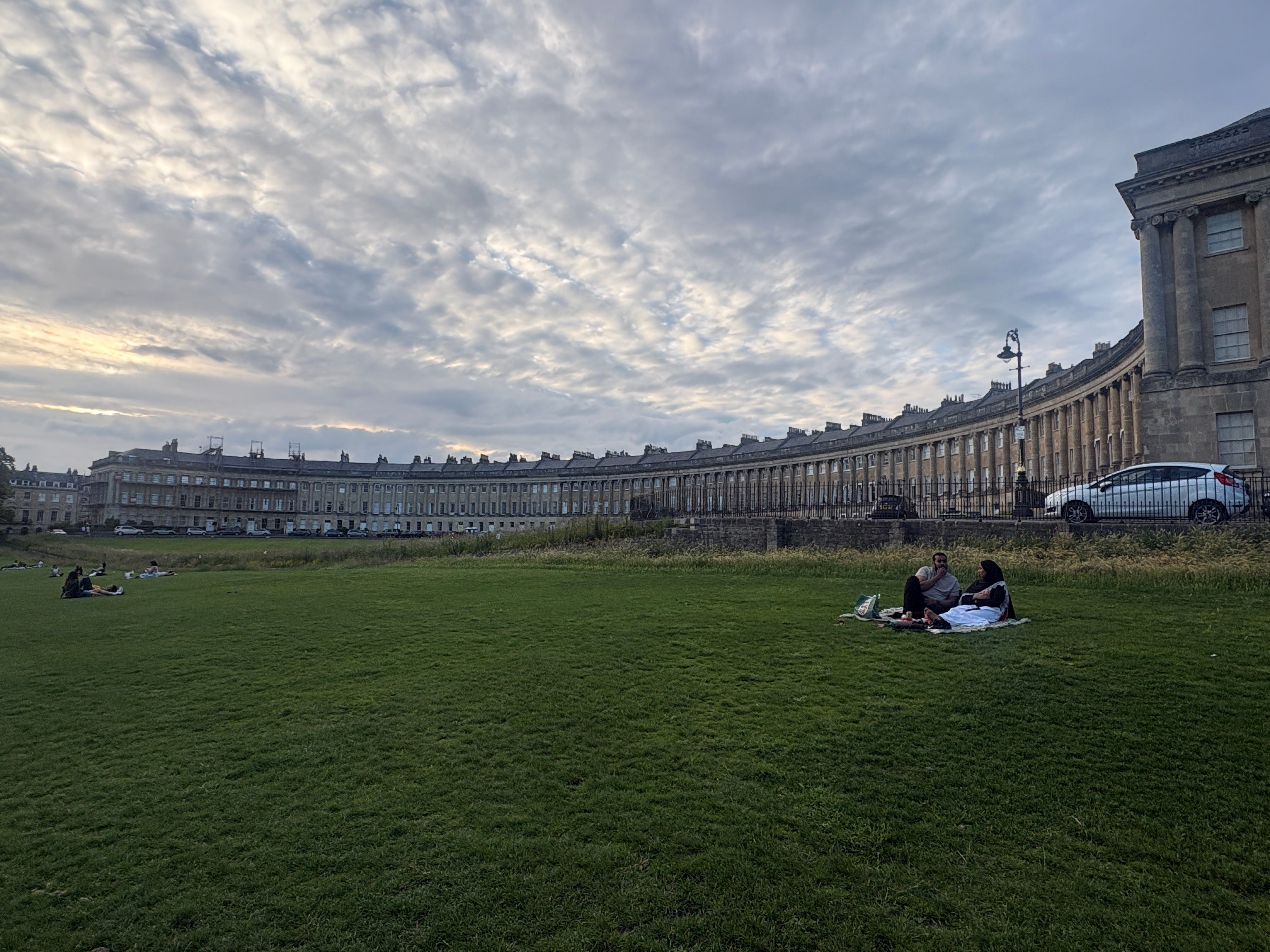
Sunset in Royal Victoria Park, Bath, UK
It has been a hot ending here, but in other parts of Europe, like France, temperatures by the coast have risen to well over 100. Tragically, in the first few days of the heatwave more than 40 people died from the heat. That number today has risen to over 1000.
It didn’t used to be this hot, everyone told us. This weather is definitely unusual. Despite the heat, locals sit on park benches reading. Visitors crowd local attractions like the Roman baths and the Jane Austen museum. But the feeling is there- it is way too hot for comfort.
Before leaving, I was able to squeeze in a visit to Mary Shelley’s House of Frankenstein exhibit before it shut down for the remainder of the week from the heat (no air conditioning in these old Georgian homes). I was glad not to miss it— despite the somewhat kitschy exhibit, I had been researching Shelley’s for months and it was such a gift to experience her story in such a visual, tactile way.
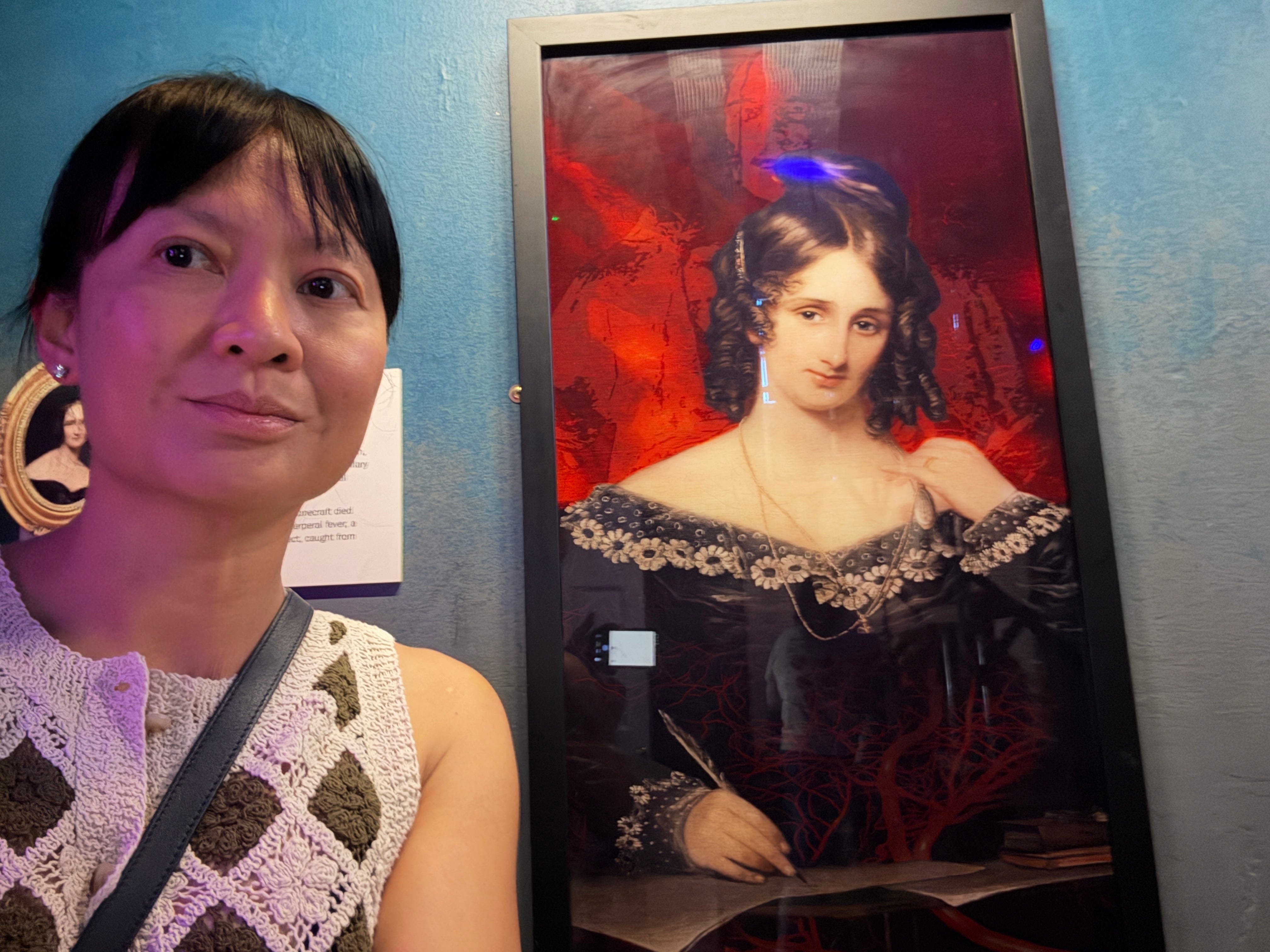
Me and Mary Shelley, House of Frankenstein, Bath, UK
The first couple floors were mostly dedicated to Mary’s early life, and the upper floors were more of an ode to Frankenstein throughout film history. The latter seemed entirely focused on showing the breadth of Frankenstein’s cultural and global reach— with movie posters from film adaptations over time and around the world, and even a Frankenstein pinball machine. My favorite find was a massive, uncanny bust of Mary Shelley that evoked her presence.
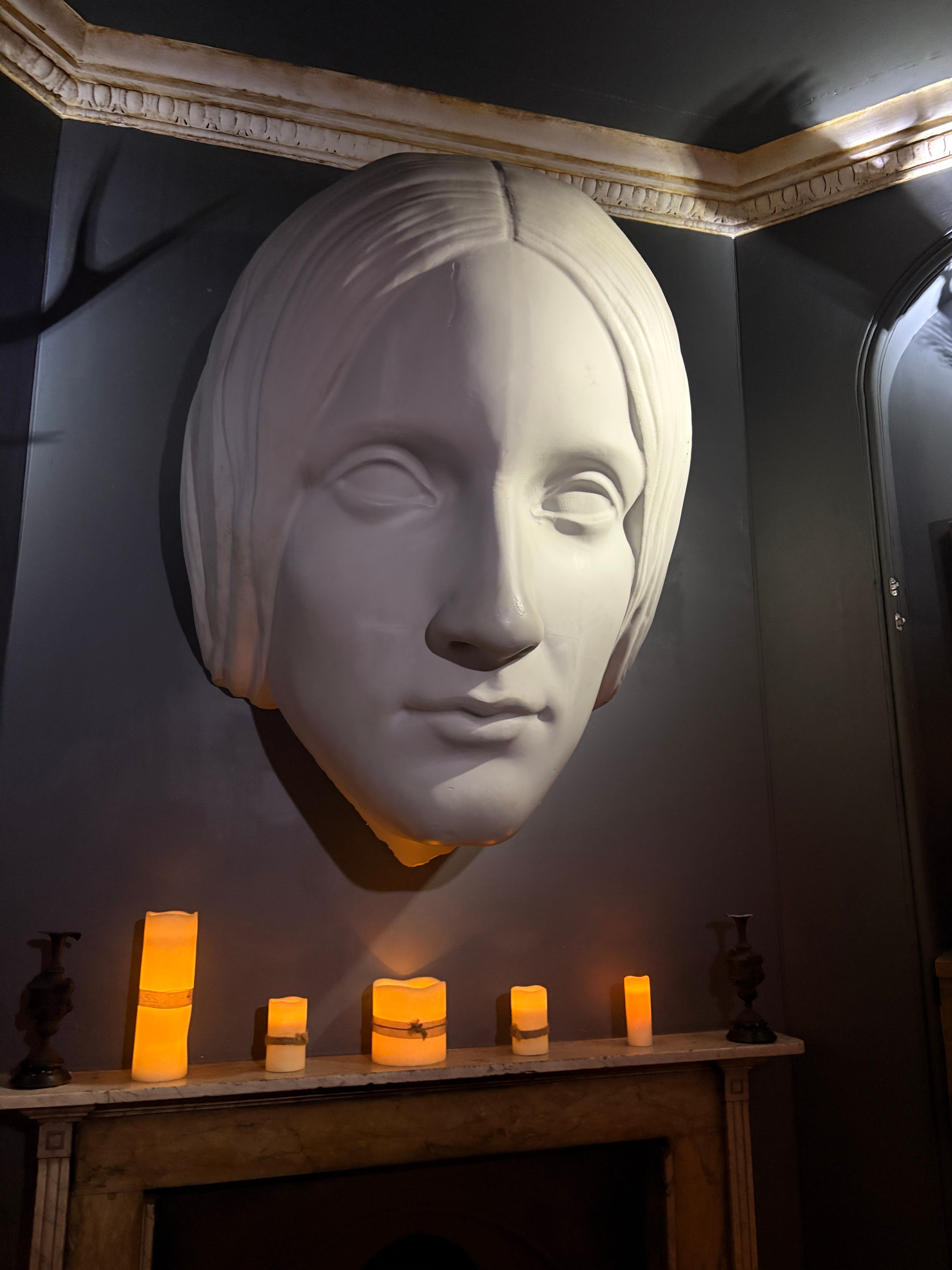
Mary Shelley, Bust display the House of Frankenstein, Bath, UK
I reread Frankenstein before coming to the UK. It had been nearly two decades since I last read it in my twenties. But back then, I didn’t think about the story in the same way. I read it without having any idea about the environmental context in which Shelley wrote it. Which brings me to my current obsession…
It wasn’t Frankenstein itself that lingered with me after reading it this time around. It was the world that produced it.
In 1815, a massive volcano called Mount Tambora erupted in Indonesia, sending an enormous amount of ash up into the Earth’s stratosphere. There it traversed the globe over Europe and the Americas, where it formed a layer of particulate so dense that it obscured the sun. The ‘year without summer’ in 1816 was the summer that Shelley wrote Frankenstein and it was one of the earliest documented examples of global climate disruption in world history.
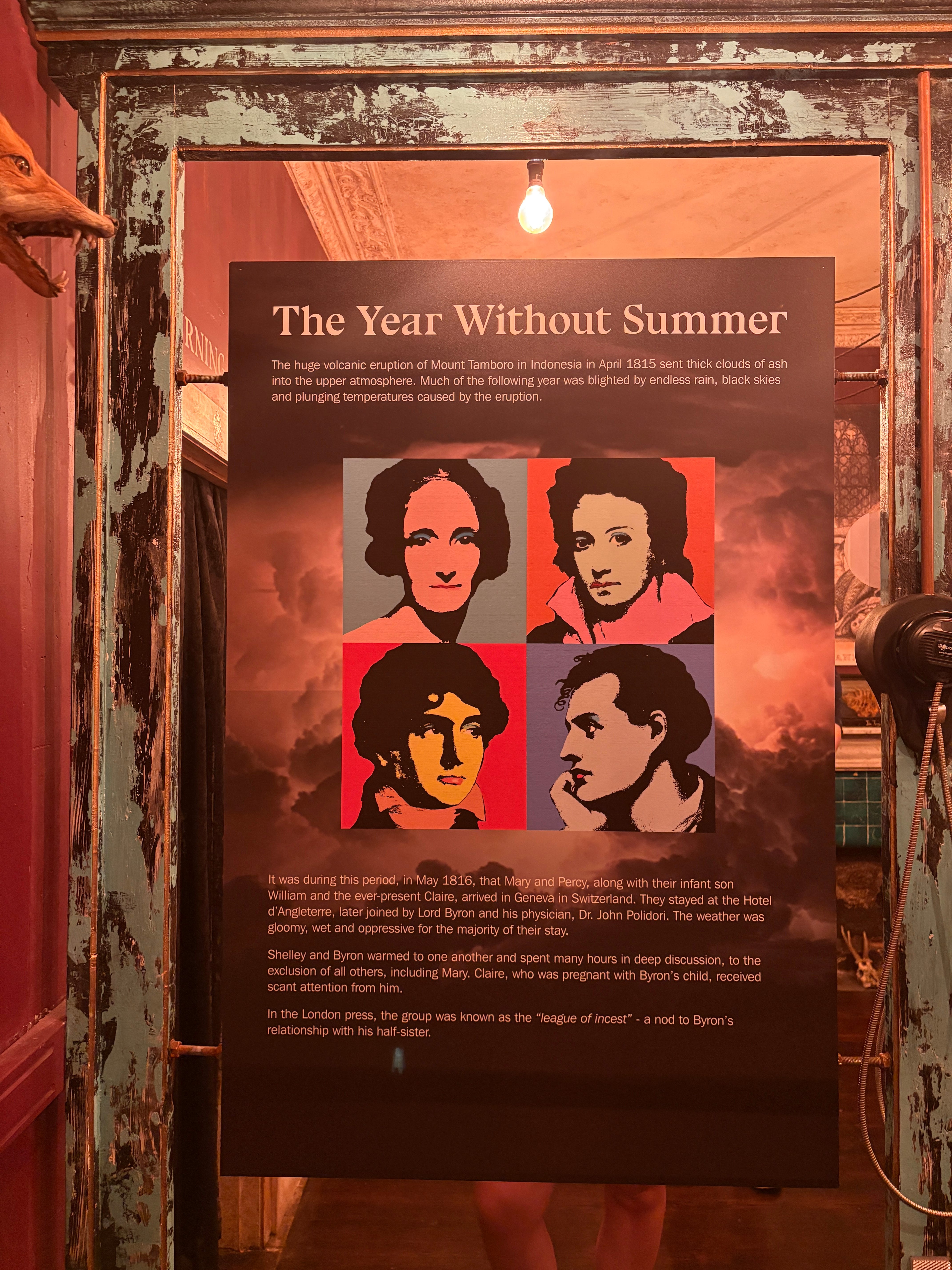
Reference to the Year Without Summer, at the House of Frankenstein in Bath, UK
Throughout Europe, torrential rainstorms and floods battered the countryside, destroying crops. Unable to harvest food, the price of bread soared and the poorest across Europe starved. Entire towns and villages were wiped out first from hunger, then disease. As famine worsened across Europe, dark spots that appeared on the sun triggered prophecies that the sun was in fact, dying.
Strange, luminous skies made the atmosphere feel particularly apocalyptic. British landscape painter J. M. W. Turner painted several of his works during this time that one can imagine might have been influenced by the way the skies actually took on a hazy, luminous glow due to the ash in the air. Below is a painting I got to get really close to at the Tate Britain, Turner’s Decline of the Carthaginian Empire.
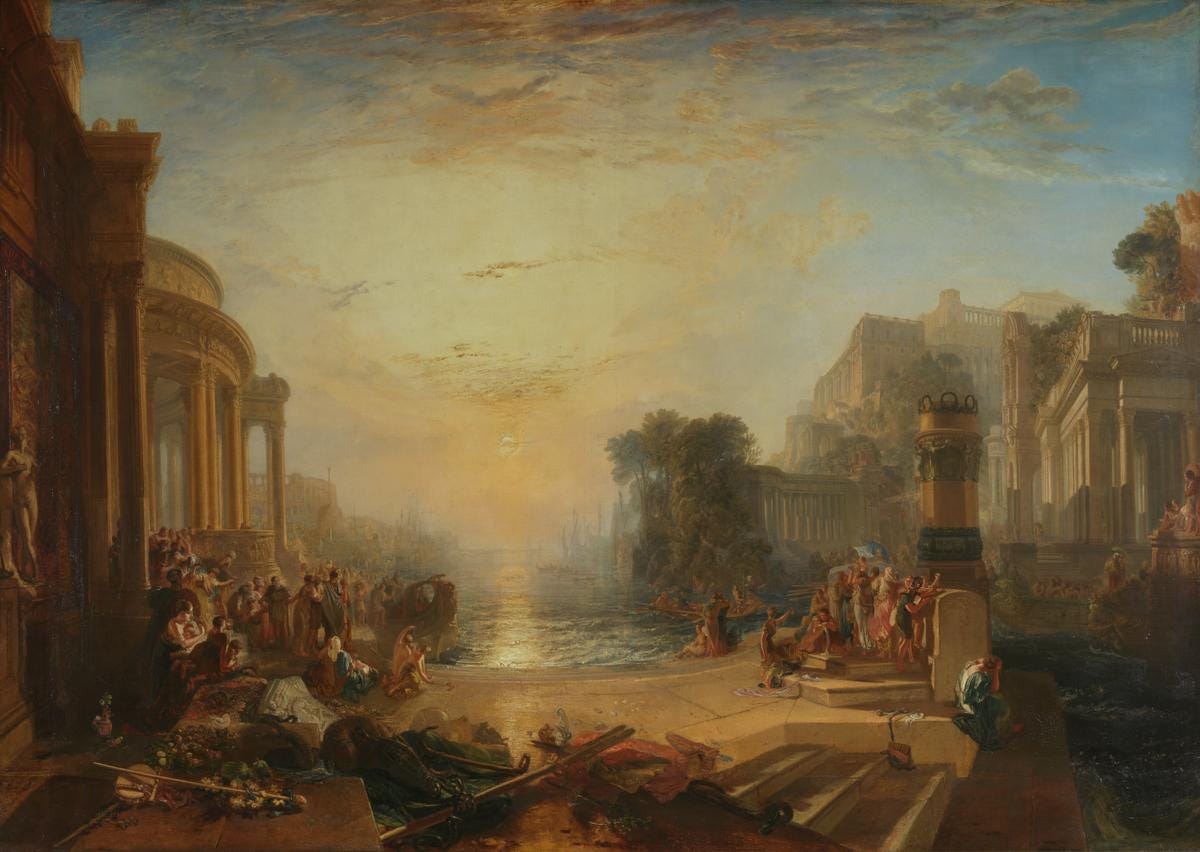
J. M. W. Turner’s Decline of the Carthingian Empire, 1817
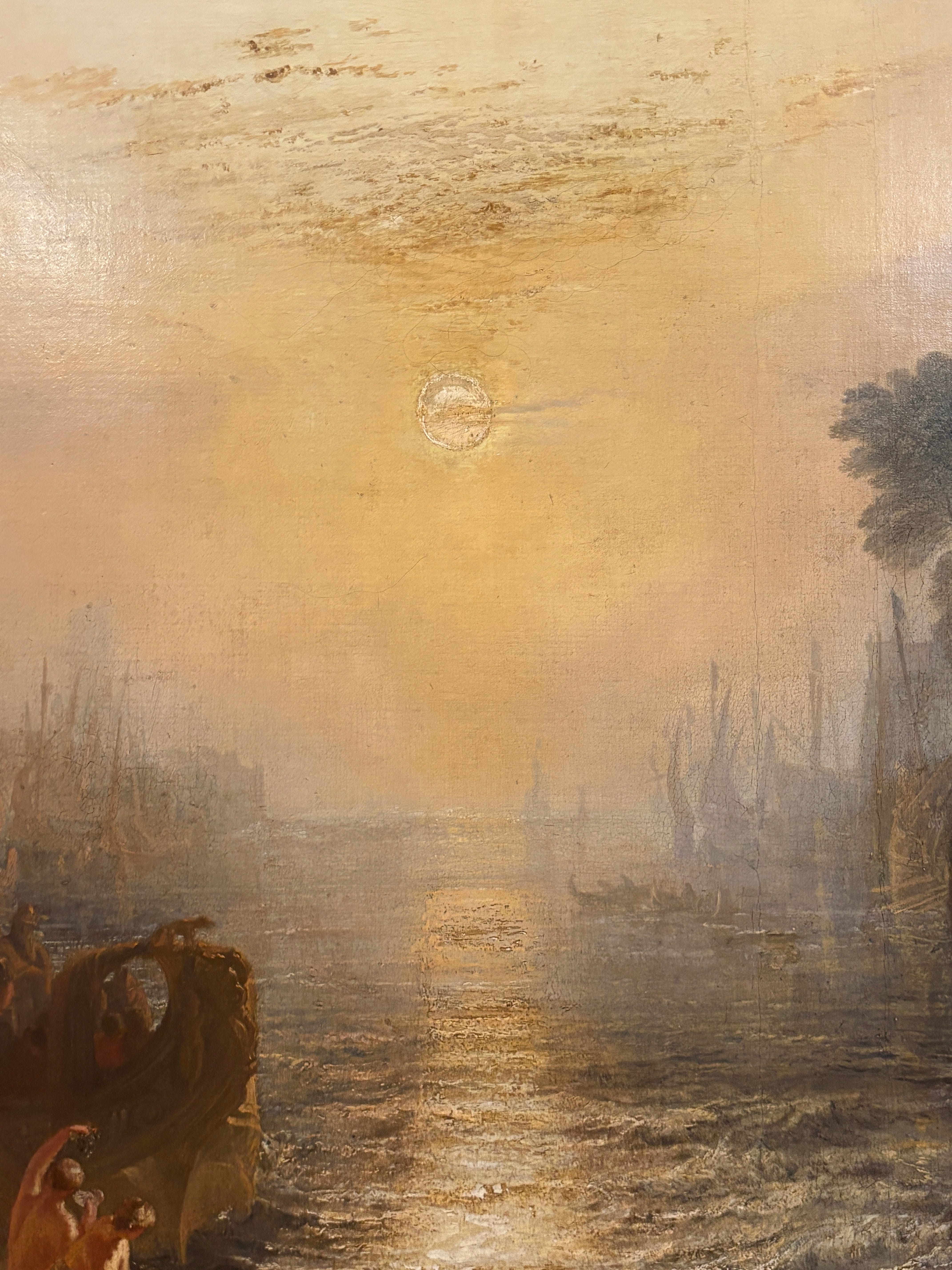
Close up detail, of J. M. W. Turner’s Decline of the Carthaginian Empire at Tate Britain
Romantic poet Lord Byron captured the essence of the summer without sun in Darkness, a poem centered around a climate-fueled apocalypse:
I had a dream, which was not all a dream.
The bright sun was extinguish’d, and the stars
Did wander darkling in the eternal space,
Rayless, and pathless, and the icy earth
Swung blind and blackening in the moonless air;
Morn came and went—and came, and brought no day,
And men forgot their passions in the dread
Of this their desolation; and all hearts
Were chill’d into a selfish prayer for light:
You can read the entire poem here.
But what was different about the climate change apocalypse in 1816 vs. the one we face today?
This is something I’ve been thinking a lot about. In Shelley’s time, nobody knew what was causing this strange change of weather, or if the sun would ever return. So many people were dying that it was impossible to ignore the reality of the uncertainty— no matter who you were, everyone stared up at the same faltering sky. In a way, I imagine 1816 must have felt a bit like the early days of the coronavirus pandemic, before an end or vaccine was in sight. The fear was real, and unifying.
Today, we know what causes climate change. Science and data points to the impact of our modern, industrialized world on nature and the health of our planet. But until we ourselves experience climate change first-hand, it is easy to brush it off to ‘another person’s problem.’ Unfortunately, scientific data alone doesn’t fuel change.
I’d like to think that humans can be wise enough to plan for the future without having to experience disaster first-hand. But maybe that is where stories come into play. Stories that help us imagine what we stand to gain and lose before the world shifts.
I think the answer lies somewhere in the ashes of 1816. Frankenstein reminds us that while facts can explain the world, stories help us imagine what it feels like to live through it. They make it emotionally real— and invite us to imagine futures before they arrive.
Perhaps that is what we need most today.
Our Story, by David Attenborough at the Natural History Museum, London